
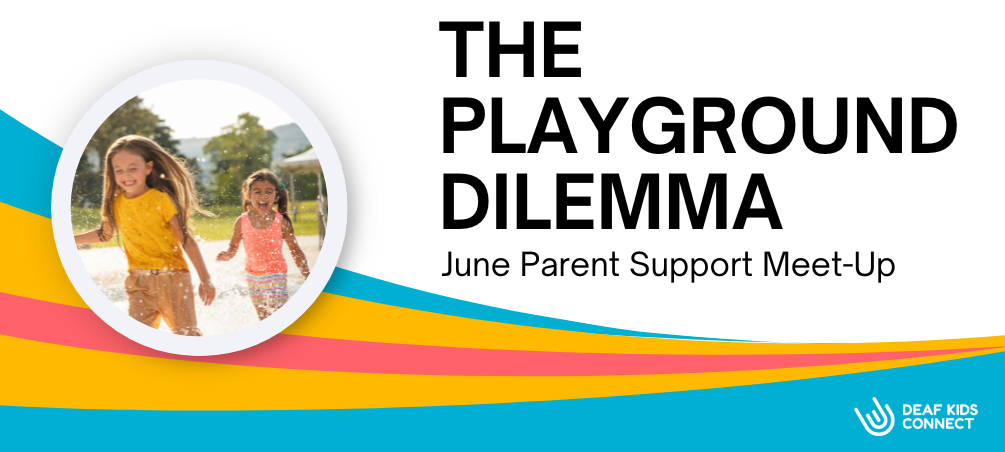
The Playground Dilemma: Supporting Communication Beyond the Playground
Hi! I’m Victoria, a hearing mom raising two daughters with my husband: one hearing and one Deaf.
Last month, I had the privilege of attending Deaf Kids Connect’s Parent Support Zoom. The topic was
The Playground Dilemma, a conversation designed to help families think through communication
at summer gatherings, playgrounds, and time spent with friends.
The discussion was divided into four simple categories that highlighted accessibility, identity,
inclusion, and healthy family relationships. These ideas apply to everyday situations while also
supporting the larger goals families may have for their Deaf children.
I left feeling encouraged because the conversation was not about creating a perfect world for our
Deaf children. Instead, it focused on practical ways we can intentionally build communication,
confidence, identity, and healthy family relationships in the middle of real life.
“Sometimes it can feel like, when you walk into a place, you’re in a room of a thousand people, and it’s almost like everybody has their back to you. But if somebody can sign, it’s as if one person of the thousand turns around and smiles at you. I’m seen. I’m known.”
You Matter
Our Deaf children deserve to know that their language, access, and experiences matter.
One of the most meaningful reminders from the evening was the picture of what it feels like to
walk into a crowded room where no one communicates in your language. Then, suddenly, one person
turns around, smiles, and signs.
That small moment communicates something much bigger:
I see you. You belong here.
“The first one is, you matter, and the ‘you’ is our child who is Deaf.”
Practical Takeaways
-
Interpret side conversations: Offer to interpret what is happening between
other people when your child is observing the conversation. -
Sign game instructions first: If your family is playing a new game, sign the
instructions before using your voice rather than talking and signing at the same time. -
Create family sign names: Have your child give family members and close friends
temporary sign names. For younger children, create simple signs or labels for people.
Small moments of access communicate something far greater than information. They communicate belonging.
You Can
Our children are capable.
While we work hard to provide communication access, we also want to equip our children to navigate
a world where many people do not know sign language. Those experiences, when supported well, can
build resilience, confidence, and self-advocacy.
“You, meaning our child who is Deaf or hard of hearing, are capable of living in a world where many people don’t know how to communicate in your language.”
In the right setting, these experiences can help children develop practical tools for understanding
what is happening around them and communicating their needs to others.
Practical Takeaways
-
Role-play: Create pretend scenarios where your child needs to ask for help from
someone who does not know how to sign. -
Connect with Deaf role models: Find people who understand your child’s experience
and can demonstrate practical ways to navigate the hearing world. -
Pause before stepping in: Give your child space to help others understand them
before immediately intervening.
It can be tempting to rescue every situation, but sometimes the greatest gift we give our children
is the opportunity to grow.
You Same
Our children deserve spaces where communication is effortless.
Life often requires Deaf children to work harder just to keep up with conversations. Creating
intentional signing environments gives them opportunities to relax, connect, and simply enjoy
being kids without constantly working to understand or be understood.
“You are the same as the other people around you. This is the idea of setting up intentional opportunities for free, easy, thoughtful communication.”
As parents, we can be creative and make room in our schedules for signing environments. These spaces
give our children a mental break from the constant effort of trying to understand and be understood.
Practical Takeaways
-
Host a voice-off gathering: Invite friends over for a meal where everyone is
encouraged to communicate using sign language. -
Plan signing playdates: Invite your child’s Deaf or signing peers over to spend
time together.
These moments remind our children that they are not alone and that sign language is something to celebrate.
Mom and Dad Matter
This final point encouraged me deeply as a mom.
Parents sometimes need a break from interpreting and advocating. At a family gathering, that may
mean sitting with an aunt and enjoying a conversation while your child plays with cousins or spends
time with someone else who signs.
Boundaries are sometimes necessary for the health of the entire family. We cannot create a perfectly
accessible world for our children, and we cannot be and do everything all the time.
“I’m a person. I’m a mom. I’m a woman. I need to eat. I need to rest. I need to have those things. And that’s a healthy balance, too.”
“It’s really good for a child to get used to their parents not doing everything. They have to learn that they need to advocate for themselves.”
Parents spend countless hours interpreting, advocating, planning, and supporting their children.
While this work is important, we are also human beings who need rest, relationships, and margin.
Sometimes it is okay to take a short break at a family gathering. It is okay to enjoy a conversation
with a relative while someone else who signs spends time with your child. It is okay to ask for help.
Healthy families recognize that parents cannot do everything all the time. This is one reason Deaf
community involvement is so important. As children grow, they also need opportunities to develop
their own self-advocacy skills.
Practical Takeaways
-
Take a party break: Tell your child that you are taking a short break to sit with
a family member you want to catch up with. -
Ask for help: Invite family members and friends who sign to step in and support
communication. -
Invite a Deaf friend: Deaf friends and mentors bring valuable understanding and
connection that hearing extended family members may not be able to provide.
Giving ourselves permission to rest is not giving less to our children. It models healthy balance
while preparing them for greater independence.
A Final Encouragement
“God is King and sovereign and developing in each of our kids, hearing or Deaf, exactly what He wants to use for them.”
One of the greatest reminders from the evening was that God is faithfully at work in every child
He has created. Every Deaf child has unique gifts, purpose, and potential, and He is using every
part of their journey to shape them for His plans.
I am so thankful for Deaf Kids Connect and the encouragement these Parent Support Zooms provide.
Connecting with other families, learning practical strategies, and remembering that we are not
alone is such a gift.
Thank you to Brittany Stacey for leading the conversation and to Daniel Woodall and Kelsey Voss
for interpreting.
Join Our Next Parent Support Zoom
We hope you’ll join us for our next Parent Support Zoom in July. We would love to see you there.