
Choosing the Right Educational Path for Your Deaf and Hard of Hearing Child
There is no one-size-fits-all education for Deaf and hard of hearing children. Some thrive in Deaf schools, others in mainstream classrooms, and still others in a mix of approaches like homeschooling or specialized programs. At our August Parent Support Zoom, we tackled this big question head-on: what educational opportunities are really out there, and how do families decide what’s best?
Parents had space to share openly: their perspectives, their feelings, their anxieties, their worries, their fears, their frustrations, and the loneliness of their battles. And woven through it all was the encouraging reminder that no plan of God’s can be messed up.
Here’s a recap of the conversation — and if you’d like to join future discussions, check out our Parent Support Zoom page.
- Public School
- State Residential School
- Private School
- Homeschool
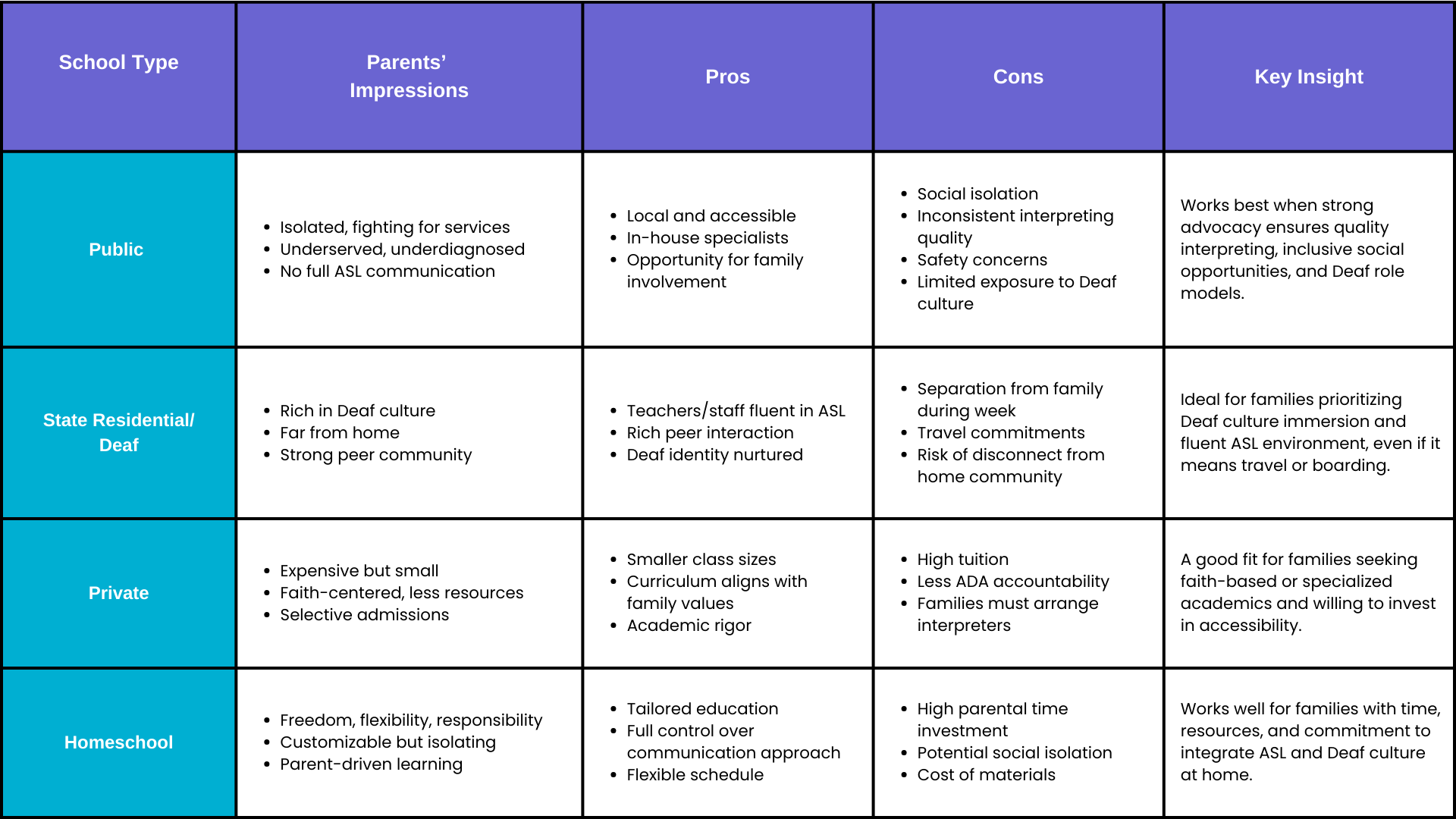
Each choice brought perspectives, real-world experiences, and honest reflections from parents who’ve been there. See the chart below.
Key Takeaways from the Group
- There’s no perfect choice—what works now may not work in a year.
- Advocacy is essential in every educational setting.
- Community matters. Regardless of school type, connecting your child with Deaf peers and Deaf role models is crucial.
In the end, every parent’s journey is deeply personal and often, deeply challenging. But we are not left to navigate these choices alone or in fear. The same Creator who designed our children, in all their beauty and uniqueness, is the One who equips us with wisdom, courage, and community.
Deaf children are not mistakes to be corrected; they are masterpieces to be celebrated. Their culture, their language, and their identity are part of God’s perfect design. And while the world may cling to its harmful philosophies, we can stand firm in the truth: no plan of God’s can be messed up.
As Phil Wickham sings, “Who brings our chaos back into order?” The King of glory, who rules the nations with truth and justice.
Public School
Public schools often provide interpreters, FM systems, and access to speech and audiology services. They’re local, free, and familiar.
Parent Impressions:
- Isolated, fighting for services
- Underserved, underdiagnosed
- No full ASL communication
Pros: Local and accessible, with in-house specialists and the opportunity for family involvement.
Cons: Social isolation, inconsistent quality of interpreting, safety concerns, and limited exposure to Deaf culture. Parents noted that while some alumni thrived, others felt their needs were not fully met.
State Residential School
These schools immerse students in Deaf culture and community, offering both boarding and commuting options.
Parent Impressions:
- Rich in Deaf culture
- Far from home
- Strong peer community
Pros: Teachers and staff are fluent in ASL, peer interaction is rich, and Deaf identity is nurtured.
Cons: Potential separation from family during the week, travel commitments, and risk of disconnect from the home community. In Alaska, one parent shared, host families provide a bridge for students who live too far to commute daily.
Private School
Private schools, often faith-based, offer smaller class sizes and unique curriculums, but vary greatly in their Deaf/Hard of Hearing accommodations.
Parent Impressions:
- Expensive but small
- Faith-centered, less resources
- Selective admissions
Pros: More individual attention, curriculum alignment with family values, and academic rigor.
Cons: High tuition, less ADA accountability, and the need for families to arrange interpreters themselves. One parent described how their child thrived academically in a private school, but only after the family invested time and resources to make it accessible.
Homeschool
Homeschooling offers the most control over curriculum, pace, and environment, making it possible to fully integrate ASL and Deaf culture.
Parent Impressions:
- Freedom, flexibility, responsibility
- Customizable but isolating
- Parent-driven learning
Pros: Tailored education, full control over communication approach, and flexibility.
Cons: High parental time investment, potential social isolation, and cost of materials. Some states offer funding for special-needs homeschooling, but policies vary widely.