
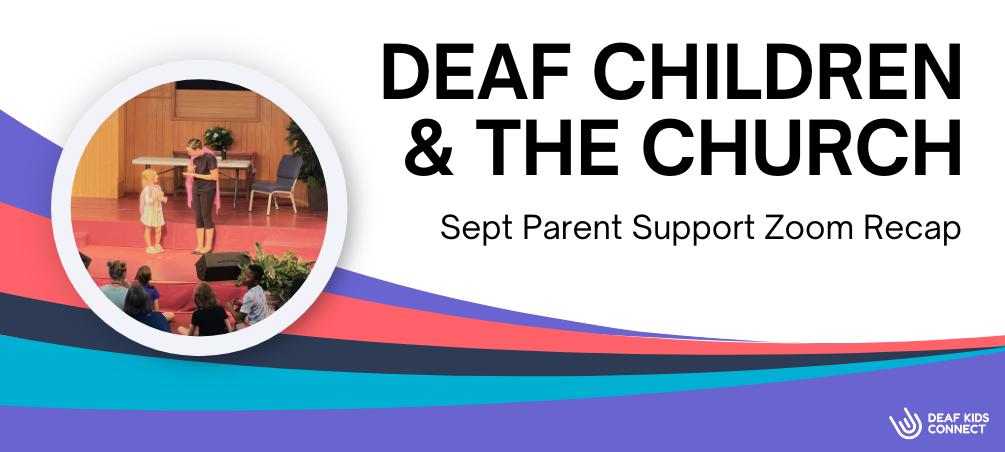
Deaf Children and the Church: Four Ways Congregations Respond
When the church truly listens, it creates a welcoming place for Deaf and Hard of Hearing children and their families at the very heart of the body of Christ. If you are a church leader, no matter the size of your congregation, I urge you to stop and reflect. Has your church ignored God’s call to serve families impacted by deafness?
When parents learn their child is Deaf or Hard of Hearing, they are often thrown into unknown territory, learning a new language, navigating technology, and advocating in places where their needs are barely understood.
Sadly, one of the hardest places to navigate is often the church. How do we make sure Deaf children are not only included, but also discipled, rooted in God’s Word, and surrounded by the community they need?
The church should be a refuge – a place where children and families are grounded in Scripture, strengthened through fellowship, and nurtured in their identity in Christ. But for families raising Deaf children, church is often the place where the gap feels widest.
Recently, parents came together to share their honest experiences of church life with Deaf children. Their stories showed both the deep pain of being left out and the incredible impact of even small steps toward inclusion. From these voices came clear lessons that every church should hear and take to heart.
When parents talked about when church is exhausting or even demeaning, their stories were heavy but real. One family shared that their Deaf son often yells to get attention, he knows yelling works because his family is hearing. In some churches, that has led to stares, frustration, and even annoyance, which left his parents feeling judged. But in their home church, the response was completely different. Instead of annoyance, people leaned in with love, how? 14 members even took ASL classes so they could communicate better with him. That kind of effort turned what could have been a place of shame into a place of belonging.
Other parents admitted that church can sometimes feel pointless. One said it’s easy to justify staying home: “I don’t talk to anybody. I can’t hear what’s being said. I don’t really connect. It just feels like a checklist.” Another said, “Here and there signs aren’t equal and not beneficial.” A mother worried her child might “fall through the cracks” because she didn’t even know what to ask for. And one powerful reminder was voiced clearly: “Our Deaf or hard-of-hearing kids want to know Jesus just as much as we do.”
For many families, going to church feels like walking in with a list of needs before anyone even knows their name. It’s exhausting. It’s isolating. And yet, the desire is the same across every story: families long for their Deaf and hearing children to grow in faith, to find community, and to know they belong.
Brittany Stacey, Family Connection Director, asked parents the two important questions: Why go to church? Getting connected to the church, but how? Parents responded:
1. To get to know Jesus
2. For community and connection
3. Fellowship
4. The Bible commands us to
You are about to read four categories of churches, how they serve families with Deaf and Hard of Hearing children, and what parents have shared about their experiences.
Category 1: Churches That Are Unwilling
Churches that simply say “no.” Parents shared stories of being told, “We understand your needs, but we’re not going to move in that direction.” These are churches that refuse to hire interpreters or invest in accessibility, without offering any other support for the family. The message families receive is clear: you’re on your own.
One family described requesting $3,000 in the budget to fund an interpreter for a church ministry. Their request was denied—despite the church having a $1.4 million budget. The hurt wasn’t only about money—it was about value. When a church with abundant resources says no to such a small request, the family hears that their child’s access to God’s Word has been rejected.
And yet, in that same story, ministry leaders themselves stepped up. A group of fathers decided they wouldn’t let the child go without. They pooled their own money and paid for the interpreter out of pocket. Later, the parents even asked a trusted pastor in another state whether it was okay to use part of their tithe for interpreter support. His response: “Yes—you’re still giving it to the church, still toward ministry.”
This testimony shows two things clearly: first, the deep pain families feel when their needs are dismissed, and second, the way God often provides through unexpected means. The conversation ended with a reminder that the right first response is always prayer. Parents may feel torn—should we stay, or should we go? But whether God calls them to remain or to leave, the call is the same: resist bitterness, pray for leadership, and trust that if a Deaf child is in a church, God is calling that church to care for them.
Practical steps for these churches include:
- Pray for God’s wisdom and guidance as you discern how to respond. Remember Jesus’ words: “If anyone will not welcome you or listen to your words, leave that home or town and shake the dust off your feet” (Matthew 10:14, NIV).
Category 2: Churches That Don’t Know
Churches that are willing to help, but simply don’t know what to do. For many, your Deaf child might be the first Deaf person they’ve ever met. Parents in this situation often describe the early days as overwhelming, trying to figure out their child’s needs while also learning how to explain them. Leaders may have genuine hearts but little knowledge of Deaf culture or resources.
For these churches, the best approach is to start with relationships. Parents suggested setting up a one-on-one meeting with a pastor or children’s ministry leader, not with a folder of demands, but with an open heart: “We want to belong here. What would it look like for our family to thrive?” Leaders aren’t Deaf educators, but they do have access to God’s wisdom. Working together step by step – Sunday School, VBS, serving opportunities – can build a path for inclusion. Parents also reminded us that discipleship is more than interpreters. Sometimes what helps most is a mentor couple checking in spiritually, asking, “Are you in the Word? Are you forgiving each other?”
Churches in this category can take small but powerful steps: offering ASL classes, forming Connect Groups to learn Deaf culture, teaching simple ASL chants in children’s ministry, or adjusting classrooms for visibility and focus. One parent described the impact of teaching the Apostles’ Creed in ASL – what began as a liturgy project turned into a ripple of hospitality and awareness across the congregation. Another shared how their church sings the doxology each week, imagining the impact of the whole church signing it together. These efforts don’t just serve Deaf children; they awaken the entire body to God’s work among them.
On the other hand, parents in these settings often feel invisible, carrying the burden alone while others assume everything is fine. The result is isolation, not just for the Deaf child, but for the whole family. Parents shared that in the early days they didn’t even know what to ask for. Walking into church, unsure how to explain their child’s needs or how to ask for support, can feel overwhelming. For some, their child was the first Deaf person the church had ever met. Yet God often uses these moments to open the eyes of congregations to a need they may have never considered.
Practical steps for these churches include:
- Begin with relationships: meet one-on-one with a pastor or ministry leader to share your family’s heart and desire to belong.
- Take small steps in ministry together – Sunday School, VBS, or simple serving opportunities – to build a pathway for inclusion.
- Offer ASL classes or short workshops to raise awareness and encourage fellowship.
- Create Connect Groups or small gatherings where members can learn about Deaf culture and practice basic signs.
- Incorporate simple ASL into worship and children’s ministry (for example, teaching the Apostles’ Creed or a worship chant in sign).
- Adjust classrooms for better visibility and focus so Deaf and Hard of Hearing children can participate fully.
Category 3: Churches That Are Willing, But Lack the Skills
Churches may not know sign language or have a ready-made plan, but they are 100 percent willing to love families and do whatever it takes. This third group is a hidden gem. Parents often worry, “But they don’t know sign. They don’t know where to start. And I don’t even know what to tell them.” But when a church says, “We are called to this, and we’ll trust God to provide,” it is powerful. And time and again, God provides, through ASL-fluent people, interpreters, or Deaf individuals who come alongside.
For families, this kind of willingness can feel like a breath of fresh air.
One parent shared how their pastor said simply, “If this child is part of my flock, then I need to learn to shepherd him.”
Within weeks, the church paid for ASL classes, not because they had a plan or extra funds, but because they believed love required it. Others told of children’s directors searching out Baby Sign users, families stumbling through greetings in ASL, or whole congregations learning to sign the doxology. Deaf children may not always notice or may even get embarrassed, but parents testified how deeply those imperfect attempts ministered to their hearts. The message is clear: “We don’t know how, but we’re with you.”
On the other hand, some churches are eager to help but don’t yet have the tools to move forward. In these places, parents often end up as the experts, expected to design, direct, and carry the ministry on their own. While the intent is good, the burden can feel overwhelming. One parent shared that it felt like every solution rested on their shoulders, while also feeling guilty for not being fluent in ASL.
In this category, love speaks louder than skill. Presence, prayer, and persistence communicate God’s heart far more than perfection ever could. Love expressed through willingness is one of the greatest gifts a church can give.
Practical steps for these churches include:
- Setting up prayer times for interpreters, volunteers, or resources.
- Hosting small gatherings like game nights, playgroups, or parent support groups.
- Joining local Deaf events – silent dinners, interpreted plays, or college interpreter programs, to learn and connect.
Category 4: Churches With Interpreters, But Families Still Isolated
Some churches provide interpreters, which is a vital first step. But interpretation alone does not guarantee belonging. Parents often share that even when sermons are accessible, their families still feel disconnected. Deaf children may sit through services but long for friendships, mentors, and peers who share their language and culture. One parent asked honestly: “Where is my child’s iron—someone who sharpens him?”
The truth is, fellowship does not end when the sermon does. Deaf children need more than access to words—they need relationships that help shape their faith. Parents have noticed that Deaf teens often lose interest in watching interpreters. What they crave is community: a Bible study led by Deaf adults, peers who share their experience, or mentors who will invest in them. Without that connection, families still carry the weight of isolation, even in well-meaning churches.
Access opens the door, but only community helps children and families belong. Churches that move beyond interpretation to real connection show Deaf children that they are not only welcomed, but wanted and needed.
True inclusion requires more than access, it requires belonging.
Practical steps for these churches include:
- Creating Deaf-led Bible studies or discipleship groups.
- Offering opportunities for Deaf children and teens to serve in ministry, not just watch.
- Encouraging pastors and leaders to meet with Deaf youth—through interpreters if needed—for prayer and encouragement.
- Building intentional peer connections, so Deaf kids are not the only ones carrying their faith experience in isolation.
Why Do Deaf and Hard of Hearing Teens Need More Than Interpreters?
One family shared that their pastor has three Deaf children, and they have two—five Deaf kids total. The parent is a professional interpreter and has given years of service as part of their tithe. Now the kids are teenagers and don’t want to watch interpreters, whether it’s mom or anyone else. The parent met with leaders many times to ask, “Could the teens watch a Deaf church online together? Could we start a Bible study led by a pastor with an interpreter?” Nothing started yet, so they’ve been praying: “God, what do You have for our community?”
In the meantime, the family chose to plug in across the church, not only in “Deaf spaces.” One daughter serves with First Impressions (greeters), the other in children’s ministry, and dad serves with First Impressions too. The parent often tells others, “If you want to communicate with our kids but don’t know how—start with eye contact and a smile. Wave. Say hi.” It does not need to be perfect. And when the kids cringe at someone’s slow signing, the parent gently says, “They’re trying to greet you—look at them, say good morning, and move on.” It blesses the greeter, and it reminds everyone that Deaf people are a blessing to hearing people too.
Key reminder for parents and churches: Deaf children are not only to be served; they are called to serve. Plant that vision early: “God made you Deaf on purpose. Our church needs you.”
Deaf children need access not just to sermons, but to relationships, mentors, and the everyday rhythms of church life that shape identity and faith. As children grow, keep asking, Where can they serve? This is not just about meeting needs, it is about growing a calling.
A Word of Hope for Parents (Matthew 18)
Brittany Stacey shared a reflection from Matthew 18. Jesus places a child in the middle of the group and says whoever receives a child in His name receives Him. He warns not to cause these “little ones” to stumble (verse 2–10), and then tells the story of the one lost sheep (verse 12–14). In that scene, a child is right there. The message is clear: God relentlessly pursues your one – your daughter or son.
There is no limit to how far He will go: not deafness, not lack of ASL access, not lack of interpreters or community will stop God from reaching your child.
When you feel overwhelmed, when leaders do not understand, say “no,” or just are not there yet, return to His beating heart. Let it guard your heart from bitterness and burnout.
Pray:“God, make my heart new. Give me Your heart for my child—and give that heart to our church leadership, pastors, Sunday school teachers, and to my child’s friends and their parents.”
He leaves the ninety nine for YOU and for YOUR CHILD.
Why Partnering with Deaf Kids Connect Matters
Every Deaf child has a God-given role in the body of Christ. They are not just recipients of ministry, they are essential members with gifts and callings the church desperately needs. Parents, too, are called to disciple their children, not to stand on the sidelines as advocates struggling alone.
By partnering with Deaf Kids Connect, churches gain tools, training, and community support so that:
- Parents are equipped and encouraged to disciple their children.
- Deaf children receive the foundation of the gospel, not just through words, but also through fellowship, peers, and a strong identity in Christ.
- Churches move from uncertainty to confidence, from willingness to action, and from isolation to belonging.
This is not a “special needs ministry.” This is the Church being the Church: one body, many members, each is necessary.
When a Deaf child walks through the doors of your congregation, God is not only inviting you to serve them. He is CALLING you to be transformed by their presence. Will you say yes?
Email us at adminteam@deafkidsconnect.com.