
How Society Constructs Disability (and How We Can Stop the Harm)
Disability is something that needs to be understood from the perspective of the person who has been designated as such.
If you are different from the collective, the mainstream in some way, they will often give you a label of some kind, independent of how you might see yourself. Clearly, some of the differences are indeed limiting. In response, society through education or rehabilitation have developed ways to minimize the impact of these limitations. These strategies can be very helpful and make people’s lives better. But members of the collective/mainstream can be quite discriminatory towards those with differences, independent once again, of how those individuals see themselves. These perspectives need to be changed as they can be quite dehumanizing.
Some see that in addressing differences/disabilities in others, there are minimally two strategies that should be employed: maximizing a person’s abilities and preventing, stopping or at worst lessening the discriminations of the social environment. It is the second of these interventions that I want to speak to briefly.
In every society, disability has been socially constructed to be seen in a particular way.
For something to be socially constructed, implies that how it is reacted to by society is not how the reaction has to be. Take the example of how women are treated in different cultures. In some they are treated as second class citizens who cannot be educated or drive cars. In others, they can be leaders of a nation. Why are there differences, as aren’t women the same everywhere? The difference is the outgrowth of culture and to some degree how the culture has chosen to understand women. The same could be said about disability in what is considered disability and then how someone with an impairment is treated.
Once again, these responses are socially constructed so arguably they could be changed should the society desire to change.
Dr. Wolf Wolfensberger was a famous disability theorist. In trying to understand how disability is socially constructed, he developed a list of the social consequences of disability. There are 18 responses he describes as “wounds” that people experience. I have had the opportunity to teach about these in several dozen countries around the world. Because they were developed in the US, I do not assume that they apply elsewhere. Whether in Asia, Africa or Europe, I always begin my discussion of them by saying, “These were developed in the United States, but tell me if they are also relevant here, in your culture.” In every case, I’ve been told they were relevant. It is therefore potentially powerful to understand these in order to mitigate or stop them. I will discuss several briefly.
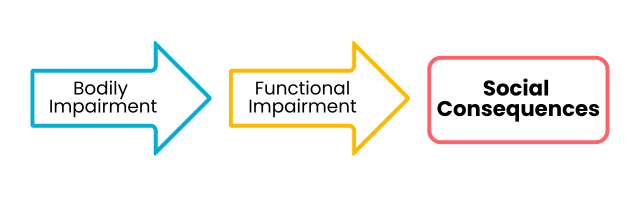
Wolfensberger begins by saying that someone has a bodily impairment that leads to functional impairment. That is, their bodily impairment prohibits them from doing something that most other people are able to do. But when society looks on people like this, there is a cascade of negativity that flows out of them, the social consequences, that are reflected in the remaining wounds.
People are then relegated to low social status and everything that travels with that valuation. This includes disproportionate and relentless rejection. Theologically, this may come from a lack of understanding of a Biblical perspective on disability leading to this treatment.
Throughout history, individuals with impairments have been relegated to what Wolfensberger calls “historic deviancy roles.” They are considered not fully human, a menace, trivium, objects of pity, as sick and diseased, as children or better off dead. It is interesting how these historic roles will be suddenly evidenced at times when the public is faced with social change. I saw this once when a group home for medically fragile children was to be placed in my community, and community members worried whether their children would be safe.
Society will also develop pejorative names for those who are different or disabled. Interestingly, I have found this is true in every culture in which I have taught about these social consequences.
Disability is a point of shame in many cultures as well and those with impairments are often blamed for any undesirable outcomes in families or communities.
As a result, people experience what Wolfensberger called “distanciation.” That is, people distance themselves from those with disabilities whether it be physical distance or social distance. This distancing leads to loneliness and results in only having people paid to be with you in your life. “Friendships” will largely only be with those who have no choice but to be with you or are paid to be with you. There is thus social and relationship discontinuity and even abandonment by family members, likely most often by fathers.
People are seen as a burden leading to material poverty and impoverishment of typical experience. It would be bad enough if this were just the experience in secular society, but Wolfensberger, who was a devout Catholic himself, states this as a characteristic of the religious community—that no religious group wants them either.
We see this too often in the Christian community where people are segregated or flat out excluded.
Being seen as having nothing to contribute and only a drain, their lives are wasted by people with power and limited imagination. All of these responses together then lead to those with disabilities being the subjects of brutalization and death through things like euthanasia and abortion.
Once again, these responses are arguably universal across cultures and societies.
The point of this discussion is for people to become aware of these wounding responses and either prevent them, stop them or minimally reduce them. The lesson is also to ask oneself,
How am I contributing the wounding of others?
As you reflect on this brief blog, recognize these wounds are real and people experience them regularly. We as a society need to change. I may not be able to improve a physical impairment such that you can walk or address an intellectual impairment so that you can understand things better. But I can definitely work to stop my complicity in you being wounded because of these differences while attempting to also intervene in the communities in which I live.
Dr. Jeff McNair
Deaf Kids Connect, Board Chair